When a Commercial Property Claim Stalls After the Initial Loss
For many East Coast property owners, the appraisal clause does not become relevant at first notice of loss. It typically surfaces later, after a significant property event has already disrupted operations and the carrier’s valuation does not match the actual scope of damage.
The point where disagreement becomes material
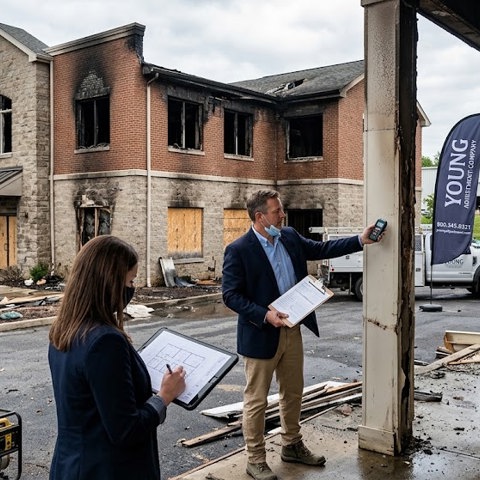
Consider a commercial building or mixed-use property in eastern Pennsylvania after a severe water loss, wind-driven rain event, or fire suppression incident. The obvious damage may include saturated drywall, damaged flooring, compromised electrical components, and affected tenant improvements. The less visible damage often follows behind it: water migration into wall cavities, microbial growth, insulation loss, warped structural components, contents damage, and code-upgrade exposure triggered during demolition and rebuild.
At that stage, a policyholder may have emergency mitigation invoices, contractor estimates, lost rental income or interrupted operations, and a carrier position that recognizes only part of the claim. The issue is no longer whether a loss occurred. The issue is the value of that loss.
If your claim has reached a valuation impasse, speak with Young Adjustment Company at 800.345.8321 or visit youngadjustment.com for a policy review.
Why the Appraisal Clause Becomes Critical in a Valuation Dispute
An insurance appraisal is a contractual process used when the policyholder and carrier agree there is covered damage but disagree on the amount of loss. It is not a full legal proceeding, and it is not designed to decide every coverage question. It is a mechanism to resolve valuation deadlock.
Where carrier-side claim handling often breaks down
This usually happens after inspections by field adjusters, independent adjusters, consultants, or carrier-retained experts produce a limited scope. Common friction points include depreciation disputes, omitted line items, under-scoped repair protocols, disagreement over matching, and failure to account for hidden damage discovered after demolition. On commercial claims, business interruption compounds the problem. Lost income, extra expense, restoration timelines, and tenant or operational disruption require disciplined documentation, not assumptions.
Appraisal may be appropriate when the carrier acknowledges damage but the numbers remain far apart despite estimate exchanges and supplemental submissions. It can be especially important when delayed resolution threatens tenant occupancy, production schedules, seasonal revenue, or financing deadlines.
For a forensic review of disputed repair scope or business income exposure, call 800.345.8321 or go to youngadjustment.com.
What a Public Adjuster Does Before and During Appraisal
A policyholder should not treat appraisal as a shortcut. It is only as strong as the documentation behind it. The process generally involves each side selecting an appraiser, with those appraisers then selecting an umpire if needed. The outcome can carry significant financial consequences, which is why preparation matters.
Building the valuation record before numbers are argued
A public adjuster’s role is to assemble and defend the true scope of loss. That begins with site documentation, estimate analysis, review of mitigation records, cause-and-origin support where necessary, contents inventory, and evaluation of concealed damage. It also means identifying ordinance and law issues, code-required upgrades, and secondary impacts that are routinely minimized when a file is pushed toward premature closure.
On a commercial claim, appraisal preparation should also include business interruption support. That means tying physical damage and restoration delays to lost revenue, extra expense, temporary relocation costs, reduced occupancy, and operational inefficiencies. When those losses are not documented in worksheets and source records, they are often discounted or separated from the core claim.
Since 1920, Young Adjustment Company has worked as a policyholder-side asset, standing between owners and carrier valuation gaps. Contact 800.345.8321 or visit youngadjustment.com to discuss whether appraisal is the right move.
What Fair Resolution Looks Like After Appraisal Is Properly Managed
A well-managed appraisal does more than increase an estimate. It helps restore the policyholder’s full financial position under the policy. That includes repair or replacement costs that reflect actual building conditions, properly supported contents losses, and a claim path that does not ignore downtime, tenant impact, or prolonged interruption.
The objective is recovery, not just disagreement
For a property owner, fair resolution means the claim is valued in a way that supports rebuild, preserves revenue continuity, and avoids leaving hidden damage or underfunded repairs behind. Appraisal is often appropriate when direct negotiations have failed, but it should be entered with a complete evidentiary file and a clear strategy for proving the amount of loss.
If your residential or commercial property claim in Greater Philadelphia or eastern Pennsylvania is stalled over valuation, speak with Young Adjustment Company about the appraisal clause and the broader claim strategy. Call 800.345.8321 or visit youngadjustment.com.